Senior Zoology Study on Hermit Island

by Stephen Sagarin, Faculty Chair

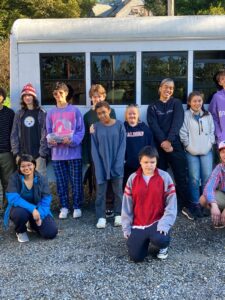
We study tide pool zoology—as scientists worldwide do—because it is likely that tide pools are the cradles of animal life on earth. The simplest animals—sponges—live here, and it may be that the water, sunlight, and biochemistry of the tide pools gave rise to the first simple animals. And, of the dozen or so animal phyla, almost all can be found on a good day at your feet in a tide pool. This year, the seven members of the Class of 2012, accompanied by Dr. Sagarin and by class parent Lydia Littlefield, traveled to Hermit Island, Maine, from September 18 to September 23.

Hermit Island is no longer an island. A sand bridge a couple of hundred yards wide divides the open sea from the calmer “Branch,” a salt marsh and muddy clam-filled tidal flat, so you can drive right to your campsite. On the way, you pass a general store at which you pay for your campsite and can buy everything from coffee, candy, and lantern wicks to ice and fresh lobsters. You also pass the “Kelp Shed,” a rambling ocean-side snack bar and hangout for campers in the summer—fireplace indoors, beach volleyball outdoors—and the site of our labs and main lessons each September. The non-island is privately owned. About half has been turned into campsites, and half is nature preserve and commercial fishing dock. It’s a bit more than a mile south to north and a few hundred yards wide.

At our campsite we collect picnic tables; one for the “kitchen,” one for the “pantry,” loaded with coolers and bins, and two for the “dining room.” Avia organizes everything, as she will all week. We set up our tents. The largest this year is for the five senior girls, who dub it the “Princess Palace.” Swags of mosquito netting frame the entrance.

We eat our first meal together, Phoebe’s spaghetti with meat sauce, then head to the Kelp Shed to meet 90 seniors from 7 other Waldorf high schools: Hawthorne Valley, Hartsbrook, Saratoga, Kimberton, Lake Champlain, Mass Bay, and Merriconeague. We have a safety talk, go over the week’s schedule, and wet ourselves in the cold ocean, ritually leaving behind life elsewhere and entering the life we will share for the week. We sing together and head to bed.

The next morning, we’re up at 6 for breakfast. Phoebe runs on the island’s dirt roads before the rest of us have our first cup of coffee. Alice makes us delicious fried egg, cheese, and bacon sandwiches. We head to the Kelp Shed for a two hour lecture on mollusks, presented by Dr. Sagarin and Ms. Dews, a teacher from the Lake Champlain school. We learn about the anatomy, physiology, and behavior of the tasty phylum of bivalves (clams and mussels), gastropods (snails), and cephalopods (octopi and squids), and examine and draw living specimens. Valves squirt, muscular “feet” extend, students squeal.

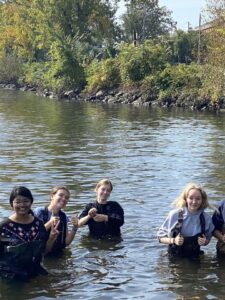
Then, a short break before a hike to the tide pools. We break into four groups of about 25 students each, accompanied by three or four teachers. Some students roll up their pants and wade in, searching for sea stars, anemones, and crabs. Others hang back at first, but, within 90 minutes, we have seen and identified more than 2 dozen animals and about 8 species of algae, and begin to feel at home in this cold, slippery, salty environment.

Back to the camp for lunch and, perhaps, a brief nap or conversation around the campfire. Kahlia entertains us with tales of the other students in her group. Then it’s off to microscope lab, beach and dune ecology, wave and fluid dynamics, or, for an artistic reprieve, painting or writing poetry on the beach. Each trip to and from the campsite requires a walk of half a mile or so. One student brought a pedometer and learns that we walk about 6 miles a day.

Now it is late afternoon on our first day. At supper we tell each other how tired we are, we move from the picnic-table dinner to a ring of camp chairs around our fire—it’s getting cold. We talk about the week ahead, then turn in before 10 p.m., the island curfew. When the island is quiet we can hear the surf drumming on the beach all night long.

Tuesday is gray and windy. The tide pools never really appear. Heavy surf pounds the coast all through low tide, throwing spray high onto the seaweed and barnacles. We watch in quiet awe from a distance and write descriptions of the zones we cannot approach.

Wednesday is calm and bright, the tide pools available and teeming with life. Low tide is close to noon, and the heat of the day and the colorful tide pools stun us with their bounty.

Days pass more or less like this, punctuated by a group bonfire for all the schools, a reading by local novelist Ellen Cooney, a contradance, and permeated by our growing familiarity with a new place and a new routine. Ben tells two stories at the group campfire and earns laughter and applause. Mollusks are followed by worms, arthropods, and echinoderms, and the tide pools begin to feel, well, if not like home, at least more comfortable. We have a lobster dinner on Thursday, accompanied by Saphire’s grilled eggplant, grilled corn on the cob, and stir-fry. Some students find it difficult to eat a lobster after meeting a live one in class the day before. Others identify the anatomy as they pry it apart, appreciating the organism and its sacrifice.

It rains, a drenching, soaking, terrible rain that floods the Princess Palace. The work we have to do doesn’t change, however, and our pace doesn’t slacken. We stretch a tarp over the kitchen and pantry and another over the dining room. Will uses the skill of a woodsman to light a large fire in the rain. We do what we have to do, just wetter than we were before.

Now it’s the end of the week, too soon in many ways, but also time to pack and head home, smelling of campfires, tattooed with mosquito bites, but filled with the beauty of the island and memories of the tide pools.

Orientation at Camp Hi-Rock, September 2011

by Stephen Sagarin, Faculty Chair

Our school year is off to an auspicious start, despite the weather, with a great Orientation at Camp Hi-Rock from Wednesday, September 7, to Friday, September 9. We arrived in rain, unpacked into a boys’ cabin and a girls’ cabin, and then hiked a few miles to Sage’s Ravine and back on the Appalachian Trail. The woods were full of more mushrooms than I’ve ever seen—large, colorful, varied. Trampled down to create low spots, the trail was under water much of the time, and flowing like a small stream in many places. For the first 15 minutes or so, we tried to skirt the wettest spots and preserve our shoes and feet. Then, one by one, we gave up and sloshed on. A stream from the camp to Bear Rock Falls, usually a muddy spot we can step across to get a view from the escarpment that overlooks the Housatonic Valley, was knee deep and rushing. Adults stood in the middle to make sure everyone crossed safely. The stream in Sage’s Ravine was roaring and impassable. Students complained and questioned the sanity of those who organized the hike, but persisted nonetheless, and, by the next day, remembered the silent beauty of the damp, green woods, the rushing water, and the carpet of mushrooms.

That evening we gathered around a fireplace indoors, ranks of sneakers and boots drying in front, and played a couple of “ice breaker” games, getting to know each other’s names and where we had come from. Then we played an extended version of charades called “Celebrity,” and the team that named itself the Papier Mache Sharks (after a large papier mache shark that hung from the ceiling of the room in which we had our fire) beat Gryffindor 39-29. Back in our cabins, we could hear drenching rain all night, and worried for those of you stuck in the valleys without an Ark.

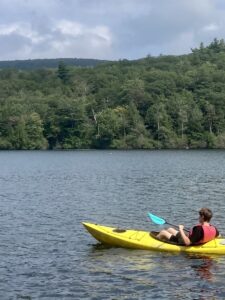
The next morning, however, the rain had abated, and we divided into two groups to complete group dynamic exercises and challenges. One group got all members over a slick 14 foot wall; the other got all members across the “peanut butter pit” by swinging on a rope and standing on a small island. By that afternoon, the sun could almost be located behind the clouds, and we spent hours at the waterfront, playing beach soccer, volleyball, swimming, sailing, and kayaking. It’s clear we’ll have our best soccer team ever this year, and possibly for several years to come. All four freshman boys are accomplished players, as are several older students.

Thursday evening we gathered first in the Dining Hall to write letters to our future selves, expressing our ambitions, goals, and wishes for the year. We sealed these and will open them next June. Then we walked, finally, to an outdoor bonfire by the waterfront to roast s’mores and talk about the school. Each year, we ask older students to reflect on their high school years and offer advice to younger students. What do you know now that you wish you had known then? What has helped you succeed in meeting your goals in high school? After this talk, some of us stayed to talk and stare into the fire while others took off to play “Manhunt” in the dark. Their flashlights arced through the mist around us like lunatic fireflies.

We spent a beautiful Friday morning at the high ropes course, and, for the first time in the eight years of Orientation, every student completed at least part of the course, climbing a giant’s ladder of logs spaced 2-3 feet apart 35 feet into the air to walk across cables and ride the zip line back to earth. After lunch, we packed, cleaned the cabins in record time, and spent a last sunny hour on the beach. A half dozen of us hiked out to North Rock to sit in silence for ten minutes or so, listening to birds, crickets, and frogs, watching fish feed near the surface, and letting the wind on the waters echo our thoughts. Then we drove back to family, school, and civilization.

Thanks to Mrs. Lombardi, fire-tender and girls’ chaperone for Wednesday night and most of Thursday, to Ms. Robbins, for Thursday night and Friday morning, and to Mr. Oelhaf, for driving us up on Wednesday and back on Friday. Thanks to Ben Havens and the staff at Camp Hi-Rock: Jenna, Brooke, Aaron, Daniel, Tom, Julian, and Colin. We had a great time.

Spring Concert Program

Here is the program for what should be a great concert! Hope to see you there:

PROGRAM

Ninth Grade Eurythmy

Stella Elliston, teacher


Waldorf High School Chorus

Mrs. Paula Nuss, Conductor

Mrs. Lee Dixon, Accompanist

Break Forth, O Beauteous Heavenly Light             Johann Sebastian Bach

Six Folk Songs                                                  Johannes Brahms

I’d Enter Your Garden

The Fiddler

How Sad Flow the Streams

Awake, Awake

A House Stands ’Neath a Willow’s Shades

At Night

Someone Like You                                             Adele Adkins,

Naomi Pitman, Solo                                     Daniel Wilson


Waldorf High School Ensemble

Gili Melamed Lev, Conductor

Sonata No. 2 in A Major for two violins               Jean-Marie LeClair

Allegro        Largo       Allegro

Alee Danyluk and Shai Lev, violins

String Quartet: “If This Were a Tango”                 Jonathan Talbott

Shai Lev and Alee Danyluk, violin

Benjamin Baum and Alice Hixon Kirk, cello

Intermission


Music from Les Choriste Bruno Coulais

Vois sur ton chemin

Compere Guilleri

Caresse sur l’ocean

Vocal Solo by Cardinale Montano

Cardinale Montano, soprano

Lee Dixon, piano

Songs                                                                Robert Schumann

Widmung

Der Nussbaum

Lied der Suleika

Songs                                                                Gabriel Fauré

Au bord de l’eau

Les berceaux

Nell

Somewhere Over the Rainbow                             Harold Arlen & E.Y.

Harburg; arr. Mark Hayes

Waldorf High School Chorus

Jabula Jesu                                                        Zulu Folk Song

Will Danz, percussion

Swingin’ with the Saints                                     arr. Mark Hayes

Puttin’ on the Ritz                                              Irving Berlin

High School Concert Sunday, June 5, 4 p.m.

Please join soloist Cardinale Montano and the Waldorf High School chorus, instrumental ensembles, and 9th grade eurythmy for a concert on Sunday, June 5, 4 p.m., at the Claire Teague Senior Center in Great Barrington, MA. We got a taste of a violin duet from Alee Danyluk and Shai Lev at the Senior Recognition Dinner last night (May 20), and the concert should be spectacular! All proceeds benefit the school, too. (Many thanks to Dorian Jackson for the beautiful poster, below.)

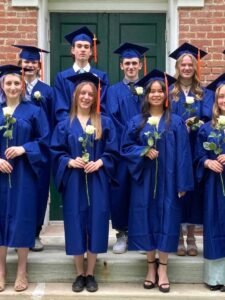
Graduation: Sunday, June 12, 2011, 1 p.m.

With great pride

the Faculty, Staff, Trustees, and

Graduating Class of 2011

of the

Great Barrington Waldorf High School

announce their

Commencement Exercises

on Sunday, the twelfth of June,

two thousand and eleven,

at one o’clock in the afternoon

in the Kellogg Music Center

at Bard College at Simon’s Rock

A Look at Graduation Requirements

In updating our school profile (sent to every college to which our students apply) and in preparing student transcripts, we created the following brief comparison of local graduation requirements and the list of academic credits that our students receive.
 
These are not intended to disparage any school or program–these are minimum requirements, and motivated students at other schools do more than the minimum. But our parents, students, and school community should know in as many ways as possible the quality and quantity of education that we provide at Waldorf!
           
Comparison of Credits Required for Graduation  
 
GBWHS BHRSD SBRSD  
    (Waldorf) (Monument) (Mt. Everett)  
English   6 4 4  
Math   4.5 2 3  
Science   4 2 3  
History/Social Science   4 3 3  
Arts   4 1 2  
Music   2 0 0  
Foreign Language   4 0 0  
Phys. Ed.   2 2 2  
Internship/Projects   0.5 0 0  
Communications   0 0.5 0  
Technology   0 0 2  
Other or elective   0.5 11.5 9  
TOTAL   31 25 28  
           

ACADEMIC CREDITS

English (6.0 credits)

English Skills I-IV, .75 credit each, 3.0 credits total

Seminars

Transcendentalists

Russian Literature

Modern Literature

Parsifal

Dante’s Divine Comedy

Bible as Literature

Shakespeare

Homer’s Odyssey

Comedy and Tragedy

Poetry

American Literature

Short Stories

Math (4.5 credits)

Skills Classes (1.0 credit each)

Intermediate Algebra

Geometry

Advanced Algebra/Precalculus

Calculus

Seminars

Statistics and Probability

Projective Geometry

Science (4.0 credits)

Biology (1.5 credits)

Zoology (with lab)

Botany (with lab)

Embryology

Cell Biology

Anatomy and Physiology

Evolution and Genetics

Physics (1.25 credits)

Astronomy

Optics, Atomic Theory

Electricity and Magnetism

Thermodynamics

Mechanics

Chemistry (1.0 credit)

Atomic theory

Organic Chemistry (with lab)

Physical Chemistry (Periodic Table; with lab)

Aqueous Chemistry

Other Science (.25 credit)

Geology/Earth Science

History/Social Science (4.0 credits)

History through Architecture

History through Music

History through Language

History through Drama

History through Art

Economics

U.S. Constitution

U.S. History I

U.S. History II

History of Technology

Modern World History

Medieval and Early Modern History

Ancient History

History and Culture of India

History and Culture of China

World Religions

Foreign Language I-IV (1 credit each; 4.0 credits total)

TOTAL ACADEMIC CREDITS: 22.0

And They’re Off! International Travel, Projects, and Internships

The Great Barrington Waldorf High School will be closed for the first three weeks of April, but that doesn’t mean the students won’t be busy and learning. Ninth and 10th grade students—joined by some older students who have not traveled in the past—will travel to Munich, Germany, or Cali, Colombia, to visit Waldorf schools there. They will live with families in these cities, visit museums and other sites, and attend classes as part of an important cultural exchange.

Other Juniors and Seniors will spend time on projects or internships that get them out in the world. This year, these include electrical engineering, pottery, fitness, stone masonry, truck repair, and early childhood teaching.

Students will report on their travel and work at a dinner to honor the Senior class on May 20, 2011.

Phoebe Rohn Attends Law Conference at Cambridge University

Phoebe Rohn, Class of 2012, is currently attending the Sixth Form Law Conference at Cambridge University, which runs from March 21 to March 24, 2011. The conference, run by a committee of current law undergraduate students, “was founded thirty-seven years ago to give Year 12 students who may be interested in studying law at degree level a balanced view of the Law, both as an academic subject and as a profession, and also to offer an insight into life as a Cambridge undergraduate.”

Phoebe is contemplating a career in international law, and chose to apply to this conference to pursue that goal. Conference topics include Roman law, intellectual property law, pro bono work, and a mock trial.

According to her family, last they heard, Phoebe “was standing along the Queen’s Way with some friends waiting to see the Duke of Edinburgh ‘on promenade.’ Apparently all Cambridge is abuzz because this weekend is the legendary Oxford-Cambridge boat race on the Thames. Needless to say, she is in her bliss!”

Following the conference, Phoebe will travel to Munich, where she will join 18 of our German students for a three week visit to the Munich-Schwabing Waldorf School.

Student Artwork on American Chemistry Council Holiday Cards

Alee Danyluk, Class of 2014

Thanks to designer Kate Hixon, parent in the Class of 2012, the American Chemistry Council, Chlorine Chemistry Division, commissioned artwork from Great Barrington Waldorf High School students to print on its holiday cards for 2010.

Aneli Poland, Class of 2013, and Alee Danyluk, Naomi Pitman, and Nicholas Sagarin, Class of 2014, worked under the guidance of Waldorf art teacher Elizabeth Lombardi and then had their work chosen and reproduced on the cards.

In exchange for the rights to use the students’ work, the American Chemistry Council donated $1000 to the Waldorf High School. This money will be used to support art programs at the school.

According to the Chemistry Council, “This work was part of a larger student art project, where the students worked from supplied imagery to honor and increase awareness for the efforts of the Chlorine Chemistry Division of the American Chemistry Council and the Chlorine Chemistry Foundation to provide clean water to areas in need, such as West Africa, and, more recently, Pakistan.”

Aneli Poland, Class of 2013

Naomi Pitman, Class of 2014

Nick Sagarin, Class of 2014

“Taming of the Shrew” Opening Soon

(Drawing by Alice Hixon, Class of 2012)

The Great Barrington Waldorf High School proudly presents William Shakespeare’s

The Taming of the Shrew

 Thursday – Saturday, February 17-19, at 7 pm & Sunday, February 20, at 2 pm

 At Berkshire South Regional Community Center, 15 Crissey Road, Great Barrington

 Suggested Donation: Adults $15, Students $8, Families $35

 For reservations, directions, or information, please call 413. 528. 8833